
I've been in technology for three decades. I've watched the industry fall in love with tools, frameworks, and buzzwords on a pretty reliable cycle. The hype peaks, the realities set in, and then the engineers quietly clean up the mess.
We're at the "quietly cleaning up the mess" stage with enterprise AI — and I realized nobody had written the architectural manual for what comes next.
So I wrote it myself.
Strategic AI: Architectural Pillars — Architecting the Multi-Agentic Platform is now available on Amazon, and it's the book I wish had existed when I started building Conflux. It's not a survey of AI concepts. It's not another "AI for executives" meditation on disruption. It's a blueprint. A layer-by-layer, engineering-grade framework for building multi-agent AI platforms that actually survive contact with production.
Why This Book, Why Now
Here's the uncomfortable truth that most AI content politely avoids: the majority of enterprise AI initiatives aren't failing because the models aren't good enough. They're failing because the architecture is wrong.
Teams are bolting AI onto existing systems and calling it transformation. They're treating agents like fancy autocomplete. They're shipping demos as products. And then they're wondering why their "AI strategy" isn't generating the returns they promised the board.
The problem isn't intelligence. It's infrastructure.
When you build a skyscraper, you don't start with the penthouse and figure out the foundation later. You start with the ground. You engineer for load, for failure, for the things nobody wants to think about when the building looks beautiful in the renderings. Multi-agent AI is no different — and most teams are building from the top down and hoping the laws of physics don't notice.
Architectural Pillars is the bottom-up manual.
What's Inside: A Layer-by-Layer Framework
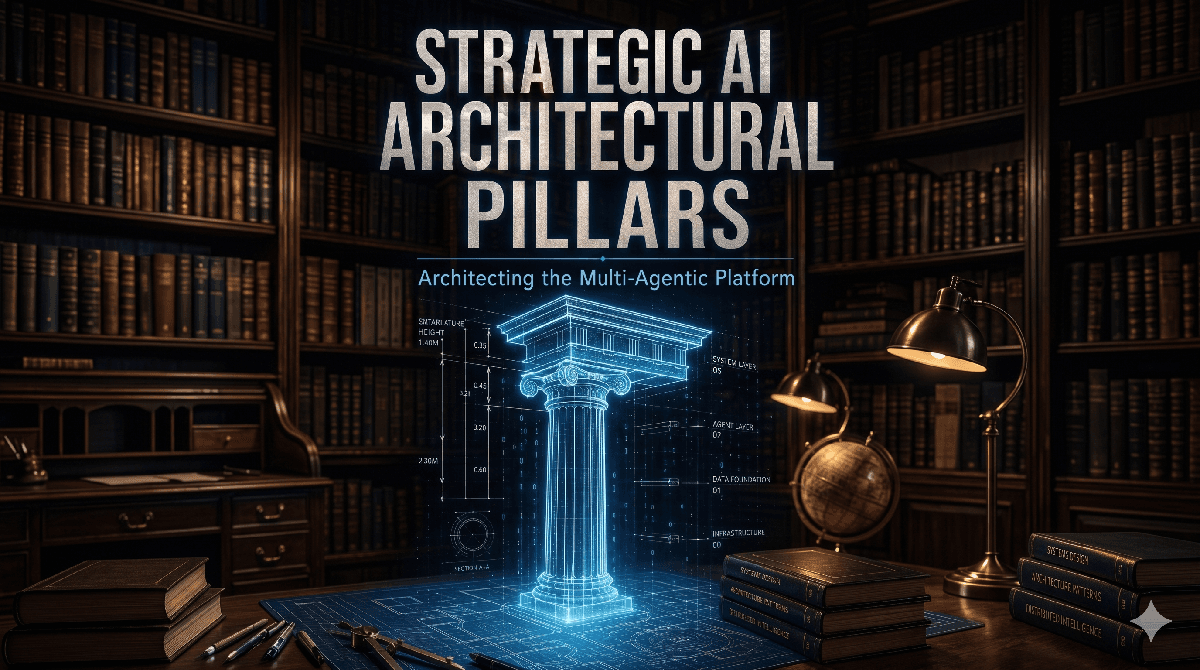
The book is organized around four architectural layers — the same layers that govern how serious distributed intelligence actually gets built:
Layer 00 — Infrastructure. The compute environments, hardware optimization decisions, and cloud architectures that have to carry the weight of AI workloads without generating a bill that ends your program. This is where most organizations undershoots and overpays simultaneously, which is a genuinely impressive feat.
Layer 01 — Data Foundation. Pipelines, vector databases, knowledge graphs. This is the layer that determines whether your agents actually know what they're doing or are confidently confabulating. Clean, context-rich, real-time data isn't optional infrastructure. It's the difference between an AI platform and an expensive magic 8-ball.
Layer 02 — Agent Layer. This is where it gets interesting. Designing autonomous, specialized agents with real decision-making logic, robust memory systems, and prompt engineering that holds up under load — not just in a Jupyter notebook. An agent that works in a demo and breaks in production isn't an agent. It's a liability.
Layer 03 — System Layer. Orchestrating multi-agent collaboration, managing state across long execution horizons, enforcing governance, and integrating with the legacy enterprise systems that aren't going anywhere. This is the layer most architects get to last and most enterprises get wrong first.
And running through all of it: design patterns for distributed intelligence built around security, predictability, and governance — not as afterthoughts, but as structural requirements from Layer 00 up.
Who This Is For
If you're an enterprise or cloud architect who has been handed the "AI infrastructure strategy" mandate and wants a rigorous framework instead of another whitepaper — this is for you.
If you're a systems engineer or software developer building, scaling, or maintaining multi-agent platforms and you're tired of content that stops at "just use LangChain" — this is for you.
If you're a CTO or tech lead who needs to future-proof a technology stack and wants something with actual engineering depth behind it — this is for you.
If you're looking for a book that tells you AI is magic and explains why your competitors are winning with it — this is not for you, and I'd gently suggest you're asking the wrong question.
The Philosophy Behind It
I've spent the last several years building Conflux, a sovereignty-first multi-agent AI platform for regulated industries — healthcare, government, rail, logistics. The industries where "move fast and break things" is not a strategy, it's a liability. Where audit trails matter more than velocity. Where governance enforced at the substrate level isn't a bureaucratic annoyance — it's the product.
Everything in Architectural Pillars comes from that lived experience. The classical architectural metaphor on the cover isn't decorative — it's intentional. The Romans didn't build the Pantheon by figuring out column placement after the dome was up. They built from principles, from load-bearing foundations, from systems designed to last centuries.
Your AI platform should be built the same way.
A Note on the Timing
We are at an inflection point. The 30-day government pre-release window for frontier models just became policy. The two-tier AI economy is forming in real time. Open-weight models are closing the performance gap with closed APIs faster than most enterprises can update their vendor agreements. The architectural decisions you make in the next 12–18 months will determine whether your AI strategy is a competitive moat or a migration nightmare.
The organizations that win aren't going to be the ones with the best prompts. They're going to be the ones with the best foundations.
Build yours right.
📖 Strategic AI: Architectural Pillars is available now on Amazon: https://www.amazon.com/Strategic-AI-Architectural-Architecting-Multi-Agentic/dp/B0H4H6W2NY/ref=sr_1_2?crid=2FI99TT7PQ03K&dib=eyJ2IjoiMSJ9._EF6koDtG0yDOQ8eFAOkpWZsQjpwRZrTzO2CtRPOjKBUVm-7hzF34xoh3z5EVXgjfEVh-0tiYDQrQOi5iOBzRoiQnr3qkIF2HGcmvBRt5p4.zD8are0rK9RJksv1IPm4OL_2VjpfCJ39pRrAyZ4n5uM&dib_tag=se&keywords=christopher+haigood&qid=1782692453&sprefix=%2Caps%2C157&sr=8-2
If you read it, I genuinely want to know what lands and what challenges your thinking. Drop a review or find me in the comments.
Christopher Haigood is the Founder & CEO of Tigunny LLC, where he builds Conflux — a sovereignty-first AI orchestration platform for regulated industries. He is the author of Strategic AI Integration and Strategic AI: Architectural Pillars.
#AI #EnterpriseAI #MultiAgentSystems #AIArchitecture #AIGovernance #TechLeadership #NewBook #ArtificialIntelligence #SoftwareEngineering #DeclaredNotEnforced