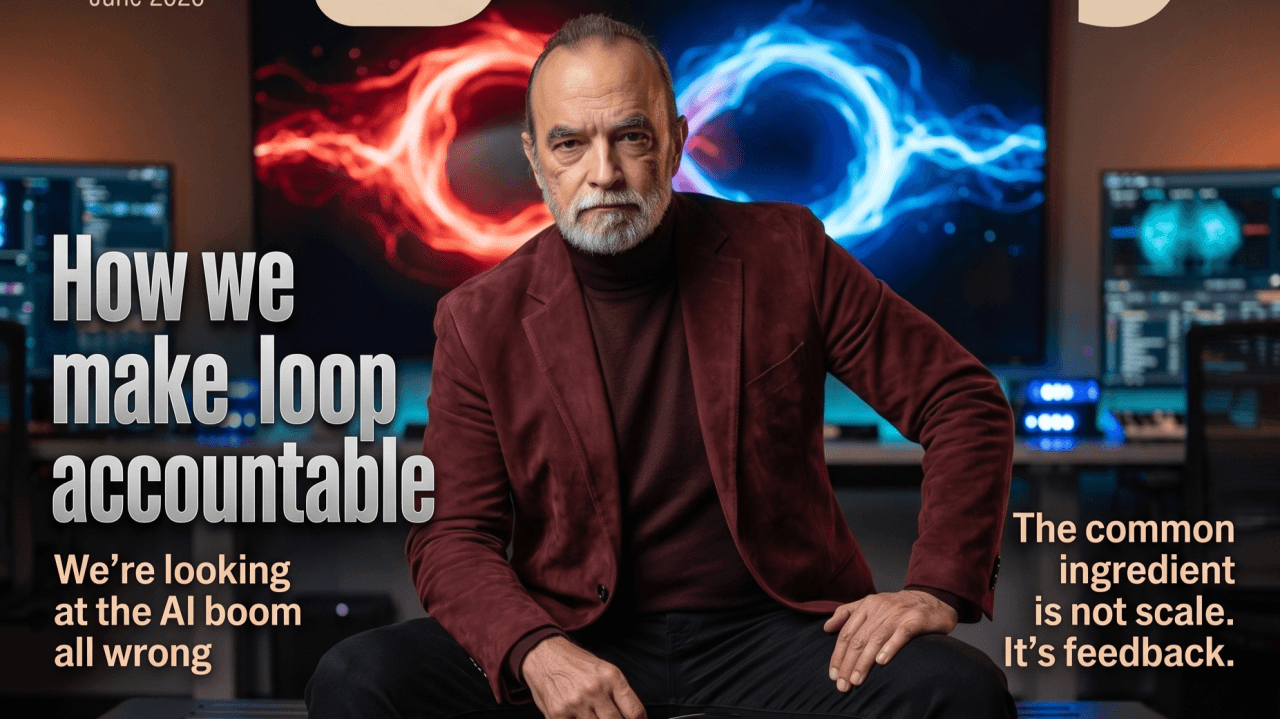
The real moat? The loop you build around it.
The premise is simple: intelligence improves when there is a feedback loop. And almost every breakthrough worth paying attention to is quietly moving in the same direction. Some models now loop internally, revisiting their own latent state to reason deeper before answering. Agent systems loop through planning, execution, reflection, and correction. Research organizations loop through evaluation, improvement, and deployment.
The common ingredient is not scale. It's feedback.
A system that can observe its own performance, compare outcomes, adapt its behavior, and try again will eventually outperform a system that produces a single answer and stops. Generate. Measure. Learn. Adapt. Repeat. The model itself doesn't have to change — the loop does.
This is why I've become increasingly interested in Recursive Self-Learning. Instead of treating an AI model as a one-shot worker, you treat it as part of an evolving system. The model proposes solutions. The harness evaluates them. The best approaches are kept. The weaker ones are discarded. New variations are generated and tested again. Intelligence emerges when a system can learn from experience — and recursion is how experience becomes capability.
In what I call Darwin Mode, the loop becomes the intelligence amplifier. Different agent strategies compete. The best survive. Weak approaches disappear. Successful behaviors spread. Over time the system evolves toward better performance, lower cost, and greater reliability. The future of AI is not a bigger brain. It's a better loop.
But here's the part most people skip
A loop is only as trustworthy as the thing measuring it.
If the harness can't be trusted to score outcomes honestly, the loop doesn't evolve toward better — it evolves toward whatever games the metric. In regulated industries, that's not a performance bug. That's a liability. A self-improving system with no enforced ground truth is a system that gets confidently wrong faster.
This is the gap I built Conflux to close. The loop is the intelligence amplifier; governance is what makes the amplification safe to deploy in healthcare, government, railroad, and logistics — domains where "the model tried something new" is not an acceptable answer to an auditor.
How we make the loop accountable
At Tigunny, the loop runs inside enforced boundaries, not on top of good intentions. A few of the mechanisms:
- Adversarial evaluation gates. Every proposed approach passes through a critical review agent whose job is to try to break it before it survives. Selection pressure only produces better behavior if something is genuinely pushing back. A loop that only rewards itself just drifts.
- Exactly-once, idempotent execution. Generate-measure-learn-adapt only works if "measure" reflects what actually happened. An effect-keyed ledger and crash-orphan recovery mean a step runs once, resumes cleanly, and never double-counts — so the feedback the loop learns from is real, not an artifact of a retry.
- Hash-chained audit trails. Every decision, every survival, every discard is written to a tamper-evident record. When a behavior spreads through the system, we can show why it won and what it beat. The loop's evolution is reconstructable, not mysterious.
- Propose-not-apply discipline. Agents generate and compete, but they don't get to silently merge their own changes into production. A human gate stands between "this approach won the tournament" and "this approach is now live." Evolution proposes; accountability decides.
The principle underneath all of it is the one that runs through everything we build: declared-not-enforced is the enemy. A loop that claims to select for reliability but can't prove it isn't a learning system — it's a story. The difference between the two is enforcement.
The real lesson
We learned this the hard way on our own platform. A green test suite is necessary but not sufficient. The deterministic tests pass, and then the live run surfaces a defect no harness predicted. That's the loop teaching you something — but only because the measurement was honest enough to catch it.
So I'll agree with the thesis and extend it: the loop is the product, and everything else is implementation. But in the domains we serve, governance is the implementation that decides whether the loop is an asset or a hazard.
The future of AI isn't a bigger brain. It's a better loop — and a loop you can actually trust.
#Tigunny #AIGovernance #RecursiveSelfLearning #RegulatedAI #DarwinMode #ResponsibleAI #AILoops #AICountability #EnterpriseAI #AIAgents #AgenticAI #LLMOps #SoftwareEngineering #AIArchitecture
Christopher Haigood is Founder & CEO of Tigunny, where he builds Conflux, a sovereignty-first governed multi-agent orchestration platform for regulated industries.