
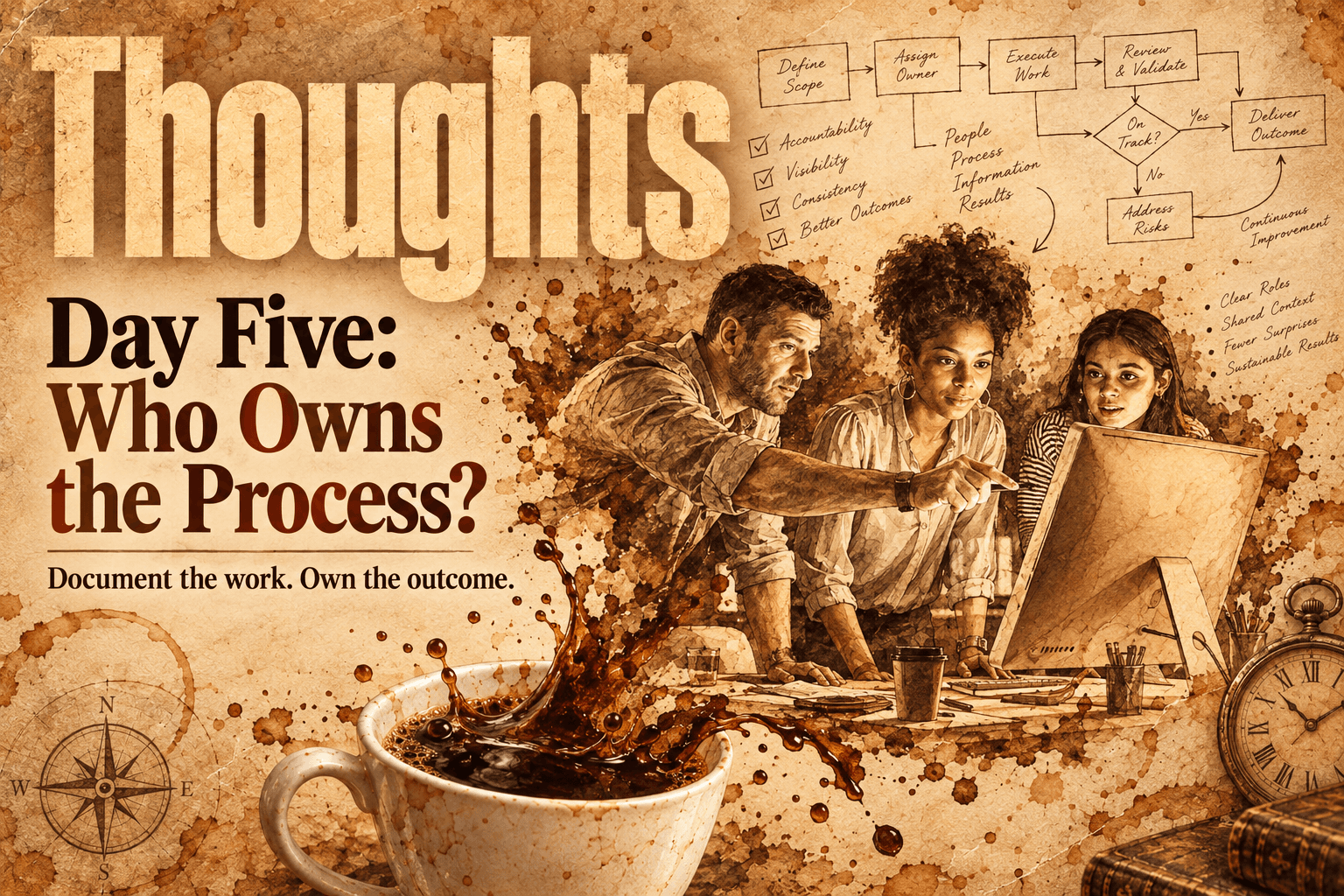
Picture the continuity review. Someone walks the leadership team through the plan: generators tested, a fuel contract in place, a binder with the phone tree. Everyone nods. Then somebody asks what the plan looks like on day five, and the room does what rooms do, which is study the table.
Everything is not fine as frog hair. As Seneca stated "The unexpected blow strikes hardest."
I’ve sat in versions of that meeting in healthcare, retail, and military work, and the pattern holds. Plans are usually solid for the outage everyone has already lived through, which is hours or maybe a couple of days. They get thin after that because nobody was asked to plan past it. The generator starts, the test gets documented, and everybody goes back to work. Whether the business can still function after the fuel truck misses its second delivery is a different conversation.
That conversation deserves some attention now. Maybe you have heard the Arthur C. Clarke quote : "Murphy's Law is a law of nature. It states that if anything can go wrong, it will. The companion law is that it will happen at the worst possible moment."
The Pentagon’s FORTRESS America initiative is aimed at reducing American military installations’ dependence on outside infrastructure. Reporting on its planning documents describes a 90-day objective for sustaining essential operations at major installations in the continental United States without outside support. There is a considerable amount of engineering between announcing that objective and achieving it, but the planning assumption is worth understanding: civilian power and supply networks may become unavailable while the mission still has to continue. FORTRESS reporting.
Britain and Japan are working on related problems at the national level. The UK launched updated “Be Ready” guidance on October 22, asking households to prepare for three days of disruption to essential services. Japan has strengthened its critical infrastructure cybersecurity framework, while its fiscal 2026 defense budget includes emergency power and improvements to base resilience. The scope and time horizons differ, but all three are putting resources into preparedness for disrupted services. UK Cabinet Office, Japan’s cybersecurity measures, Japan’s defense budget.
I would be careful about turning those announcements into a prediction. Britain’s household guidance explicitly includes severe weather, and Japan has plenty of reasons to take disaster preparedness seriously. These programs address a wider range of risks than any single adversary. What matters to a business is that governments are planning around interruptions to services most companies assume will remain available.
Iran belongs in that discussion. In July, CISA, the FBI, the EPA, and other federal partners updated their warning about Iranian-affiliated actors targeting industrial control devices across American critical infrastructure. The agencies described activity affecting water, energy, and government facilities, including manipulation of control-system information and operational disruption. The threat reaches into the equipment and information people use to keep essential services running. CISA joint warning.
And Iran needs to be understood in the context of its relationships with other states. The U.S. intelligence community describes selective cooperation among Iran, Russia, China, and North Korea that strengthens the threats each presents. It also says those relationships have limits, are primarily bilateral, and are constrained by competing interests. That distinction matters. Cooperation deserves attention; assuming every incident is part of one coordinated operation goes beyond the evidence. 2026 Annual Threat Assessment.
For continuity planning, I’d want to know whether we can handle several dependencies failing at once. A telecommunications outage can complicate a fuel shortage. A compromised supplier can interrupt operations even when our own systems are healthy. Separate incidents can converge on the same business process without anyone having coordinated them.
The process still has to work. And before we can decide whether it will survive a disruption, somebody needs to explain how it works today.
Across the industries I’ve worked in, the failure often looks familiar. The physical asset survives, but the information needed to operate it becomes unavailable. A hospital keeps the lights on and loses access to the records, inventory, or transfer coordination its staff need. A logistics operator has trucks and drivers but cannot reliably determine which shipment goes where. A railroad has equipment available while the systems supporting dispatch and coordination are degraded.
Take a hospital supply request. The normal process might run from a clinical unit through inventory, purchasing, supplier confirmation, receiving, and delivery back to the unit. The outcome is that the unit receives the correct supplies in time to support care. Sending a purchase order is one activity along the way.
Now walk that process through day five. The inventory application is unreachable. The supplier portal is down. Communications are intermittent. Who can authorize a substitute? Where is the local inventory record? How does receiving document a partial delivery? Who confirms the supplies reached the unit? When systems return, who reconciles the emergency transactions so purchasing does not order everything a second time?
That brings me to three operational questions I would put in front of any leadership team: Is the process documented? Who owns the process? Who owns the outcome? Those sound simple until you ask them across departments and discover that everyone owns their particular step, but nobody can explain who is responsible for getting the work all the way through.
That is where my engineering questions start. What information must be available locally? How current does it need to be? Who can make a decision when the normal approval system is unreachable? What happens to the work completed while the connection is down?
Those questions give the continuity plan something concrete to address.
A generator cannot answer any of those questions, although it will make enough noise to suggest something productive is happening.
When I walk through this with a team, I want six things established:
- The critical process is documented, including handoffs, decisions, exceptions, and a defined outcome.
- The process owner and outcome owner are named, with backups and clear decision authority.
- Each site can perform its critical workflows with the people, systems, and data available there.
- Work completed while disconnected is recorded and can be reconciled when connections return.
- Leadership has decided what gets priority when power, supplies, staffing, or communications are limited.
- Every critical outside dependency has a tested fallback or an explicit decision about how long the business can tolerate losing it.
There is ordinary engineering in that list: local application state, protected copies of essential data, queued transactions, and synchronization with clear rules for conflicts and duplicate submissions. There are also operating decisions that engineers cannot make on leadership’s behalf. Somebody has to decide which services continue, which work waits, and who has authority to change those priorities.
I would want to see those decisions exercised. A diagram showing a backup connection tells me what someone intended to build. Running the workflow with the primary connection unavailable tells me considerably more.
The same applies to fuel contracts, alternate suppliers, and recovery plans. Who else depends on that supplier? Does its emergency process require a cloud application? Can the alternate carrier reach the site? Can another employee perform the task if the person who normally handles it is looking after their family?
Most teams that trace a critical function from beginning to end find something they had overlooked. Sometimes it is a remote authentication service. Sometimes it is a supplier’s ordering portal. Sometimes it is the spreadsheet Carol updates every Friday, which has quietly become infrastructure without ever receiving the budget or documentation that usually comes with the title.
So here is where I would start. Put operations, IT, and compliance in the same room for two hours. Name the three functions the organization must keep running. Trace what each one needs: people, data, equipment, supplies, connections, and decisions. Mark the dependencies outside your control, assign owners to the gaps, and choose one workflow to exercise with its normal external services unavailable.
Then ask the day-five question again.
You may discover that the generator is fine. It is the business process sitting beside it that needs some work
#BusinessContinuity #OperationalResilience #BPMN #ProcessOwnership #ProcessMapping #CriticalInfrastructure #CyberResilience #RiskManagement #Tigunny
Christopher Haigood is Founder & CEO of Tigunny LLC, a Fort Worth–based SDVOSB and Texas HUB-certified AI platform company, and the author of "Strategic AI Integration" and "Strategic AI: Architectural Pillars Architecting the Multi-Agentic Platform"